Petroleum operations,
from the tanker to the station.
Fuel changes hands many times between the depot and the customer, and most of the arguments happen where nobody was watching. GSS builds the systems that keep the record: where the truck was, what the valve was doing, who signed for the delivery, and whether the station stayed powered while it all happened.
Fuel goes missing in the gaps between systems.
What operators live with
- A tanker's route sits in one portal and its camera footage in another
- Losses show up at the end of the month, not on the day
- A disputed delivery comes down to the driver's word against the client's
- Fuel is settled on claims rather than on distance actually driven
- A power cut stops dispensing and nobody knows until a customer calls
What GSS puts in place
- One record per vehicle per day: position, video, events and fuel together
- Valve activity read from the truck's own camera and stored with the image
- Deliveries verified by time, place and visual evidence
- Fuel settled against kilometres driven
- Station power designed, installed and monitored by the same company
The whole operation, not just the software.
This is what separates GSS from a tracking vendor. The engineers who write the dispatch software work in the same company as the engineers who build the main distribution board. A petroleum client hands over the vehicles, the forecourt and the control room as one scope of work, instead of managing four suppliers who blame each other when something stops.
On the tanker
- GPS tracking and full day route replay
- MDVR and vehicle cameras
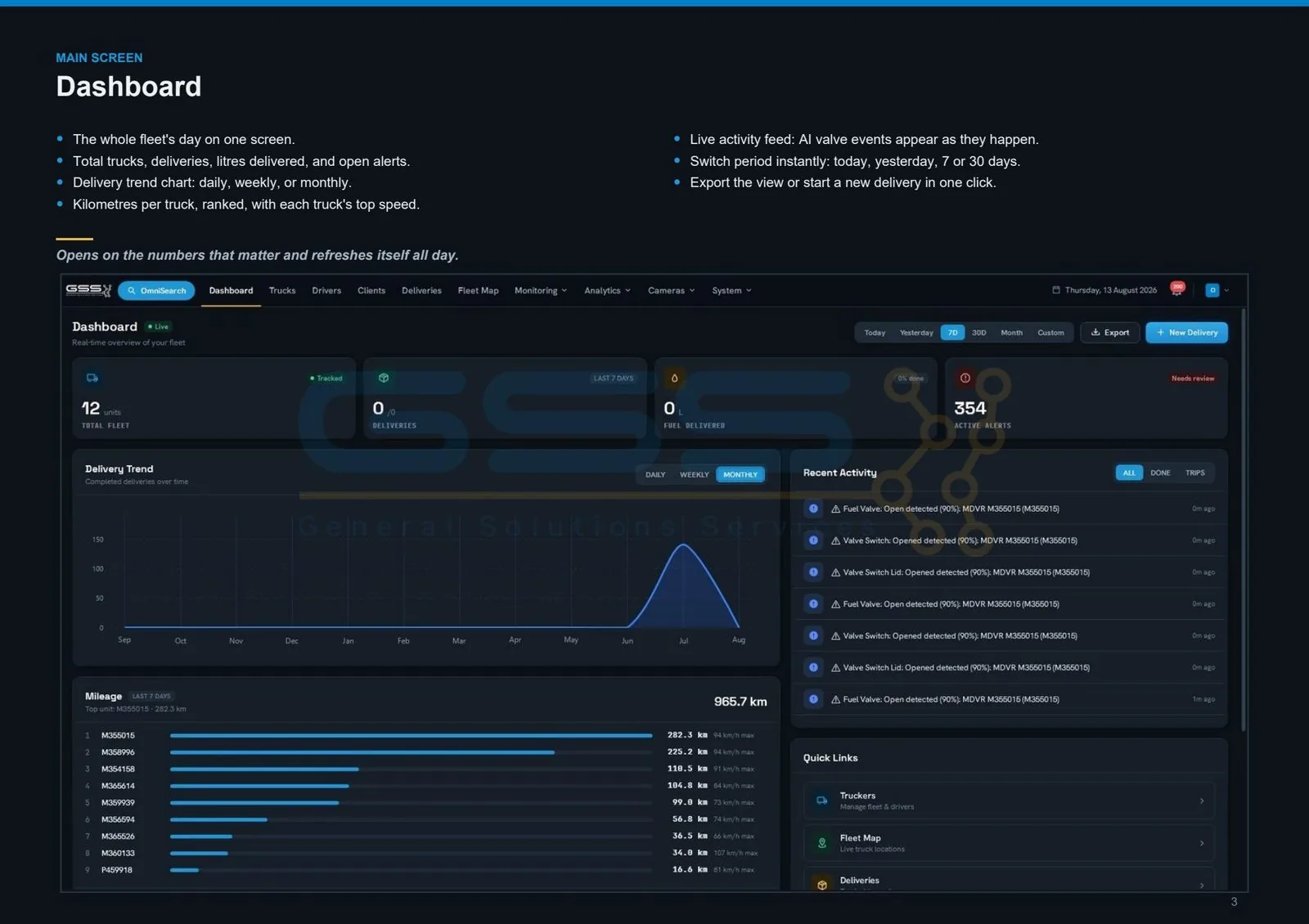
- Fuel valve state read from camera frames by AI
- Photo evidence kept against every fuel event
- Driver behaviour and route deviation alerts
- Delivery verification at the point of discharge
At the depot and station
- CCTV across forecourt, tanks and discharge points
- LPR and plate recognition at gates
- Access control for staff and contractors
- Geofencing around depots, stations and customer sites
- Control room screens showing fleet and site together
Power and electromechanical
- Station and depot power distribution, MDB and sub boards
- Automatic transfer switching, so dispensing survives a grid cut
- PLC automation and control panels
- Plant rooms, pumps and HVAC for control rooms
- Structured cabling and networks across the site
- Solar and EV charging where the site can carry it
Reporting and AI
- Scheduled reports to operations and to management
- Questions asked in plain language, answered from your records
- Fuel and delivery anomalies raised the day they occur
- Operational KPIs per vehicle, per driver and per site
A survey first, never a price list.
Most petroleum projects start on a handful of tankers and one station, so the operation can see the evidence before committing the whole fleet. Nothing here is off the shelf: the rules, the reports and the alerts are built around the way your operation already runs.
The things people ask first.
Can you monitor fuel valves with cameras?
Yes. Valve state is read from the truck's own camera frames by AI, and the image is stored against the event, so a fuel dispute has a picture attached to it.
Do you handle the station power as well as the software?
Yes, and that is the difference. GSS builds the distribution board, the automatic transfer switching, the PLC panels, the plant room and the HVAC, and writes the software that runs over them.
Will it work with the trackers already on our tankers?
It depends on what those trackers expose. Where there is an API, an SDK or a documented feed we connect to it. Where there is not, we propose compatible equipment and say so before you commit.
Can we start with a few tankers instead of the whole fleet?
That is how most petroleum projects here start: a handful of tankers and one station, so the operation sees the evidence before the fleet is committed.
Tell us about your operation.
How many tankers, how many stations, what is on the trucks today, and where you think the money is going. We will tell you honestly what can be integrated and what needs replacing, before anyone talks about budget.